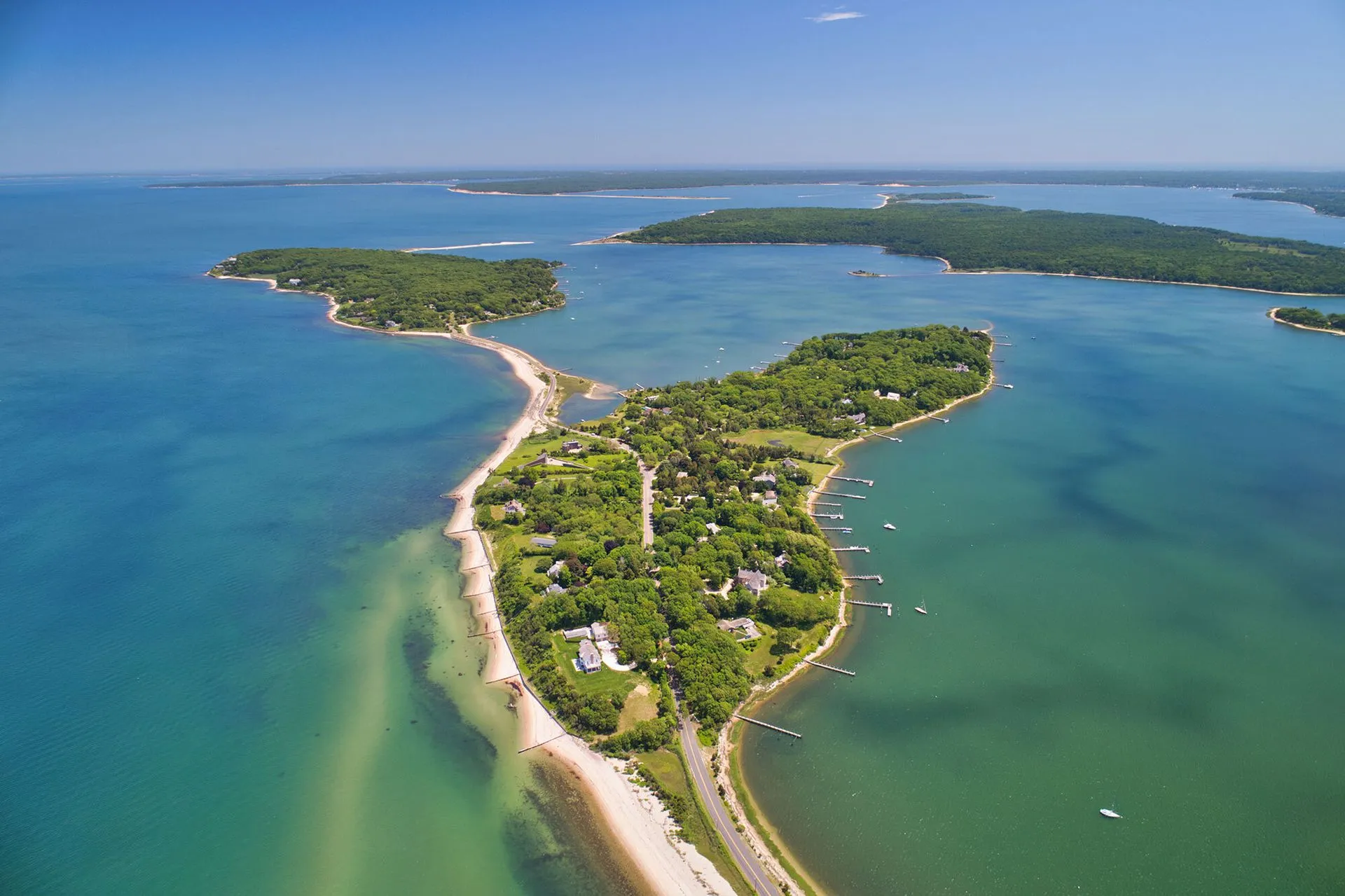
Sagaponack is the smallest incorporated village in New York, defined by working farm fields more than any commercial base. An owner selling investment property here is almost never trading out of a retail building or an apartment complex — they're usually trading out of land or a large single-family house held for rental income.
Farmland, Not Storefronts
Much of Sagaponack's open acreage carries development-rights restrictions from purchased agricultural easements, which permanently cap non-farm use on that land. That's good for keeping the fields intact, but it materially narrows what counts as viable like-kind replacement stock for an owner trying to exit an easement-encumbered parcel — the easement travels with the land, not with the exchange.
Outside the farm fields, the village is almost entirely large-lot single-family estates, some rented seasonally, with essentially no multifamily or retail inventory. Ocean-side parcels near Sagg Main Beach carry some of the highest per-acre land values on the South Fork, but that value sits almost entirely in the land and the house, not in any income-producing use, since short-term seasonal rental is the only realistic revenue a Sagaponack estate generates.
The Inventory Problem Nobody Flags Up Front
A standard 1031 coordination quote assumes there's comparable inventory near the relinquished property. In Sagaponack there frequently isn't any inventory at all inside the village line — not thin, absent. A provider that doesn't say this in the first conversation is setting the client up to discover it themselves after the clock has already started.
The honest version of the scope names the constraint early: the identification list has to travel outside the village from day one, most often toward Bridgehampton or Water Mill. Any purchase inside the village also falls under the Town of Southampton's Community Preservation Fund, so the buyer-side 2% transfer tax applies on top of an already high acquisition price, and that cost needs to be modeled into the deal before it's compared against a replacement candidate in a town without that fund.
What Investors Actually Trade In and Around Sagaponack
The realistic candidate set for an owner exiting Sagaponack property includes:
- large single-family rental homes in neighboring hamlets
- unrestricted land parcels without agricultural easements
- DST placements when no direct replacement will close in time
- improved residential property with existing rental history
Oceanfront and ocean-adjacent parcels in and around the village also carry coastal erosion hazard area review and DEC wetlands jurisdiction for anything close to Sagg Pond or the dune line, which affects both what can be rebuilt after storm damage and how a lender treats the property's long-term structural risk. That review adds real time to any exchange that depends on construction or renovation closing out inside the 180-day window, and it should be flagged before the property is added to an identification list, not discovered afterward.
Identification Strategy Under Zero Local Stock
With no meaningful comp set inside the village, the identification list under the three-property rule almost always needs candidates from adjacent hamlets named well before the 45-day deadline, along with a documented reason for looking outside Sagaponack. That documentation matters for the file, and it's the kind of step a generic proposal treats as an afterthought instead of the actual starting point.
Rental income figures should also carry a seasonal caveat when they're used to support a candidate's value. A Sagaponack estate's rental history is almost always a short summer season rather than a stabilized year-round lease, and treating that summer number as if it applied to all twelve months overstates the income the property actually produces.
Common 1031 Exchange Questions
Does an agricultural easement on Sagaponack land affect a 1031 exchange?
The easement itself doesn't block the exchange, but it does limit the property's use and value, which affects what counts as a genuinely comparable replacement and should be reviewed with a tax advisor before the sale closes. A parcel encumbered by a purchased development-rights easement generally isn't a like-kind match for unrestricted land, since the value and permitted use of the two differ enough to matter for the replacement-value test.
Is there realistic replacement inventory inside Sagaponack itself?
Rarely. The village is small and mostly farmland or large private estates, so most Sagaponack exchanges identify replacement candidates in neighboring hamlets rather than within the village line. Waiting to see what turns up locally before widening the search usually just costs time on the 45-day clock.
Why does a generic 1031 quote underprice Sagaponack work?
Because it assumes a normal local comp set exists to identify against. Sagaponack often has none, so the search has to start wider immediately, which takes more coordination time than a template proposal accounts for. A quote that doesn't flag this in the first conversation usually gets renegotiated mid-exchange once the actual scope becomes clear.
Can a rented single-family home in Sagaponack qualify as investment property?
It can, as long as it's genuinely held for rental income and not primarily personal use, which needs to be documented consistently with how the property was actually operated before the sale.
Does coastal review affect an oceanfront Sagaponack exchange?
Parcels near the dune line or Sagg Pond can fall under coastal erosion hazard area and DEC wetlands review before rebuilding or expanding a structure, which can add real time to an improvement exchange and should be factored into the closing timeline early.